
A dramatic photograph appears in your feed. A familiar voice makes a shocking announcement. A news article describes an event you have never heard about. Everything looks convincing—but where did it come from?
Generative AI can create realistic text, images, video, and audio, including material that shows no obvious signs of manipulation. The Associated Press recommends tracing the original source, checking images, and looking for corroborating reports when verifying suspicious content.
AI-generated does not automatically mean false, and human-written does not automatically mean accurate. Your goal is to establish whether the claim has reliable evidence behind it.
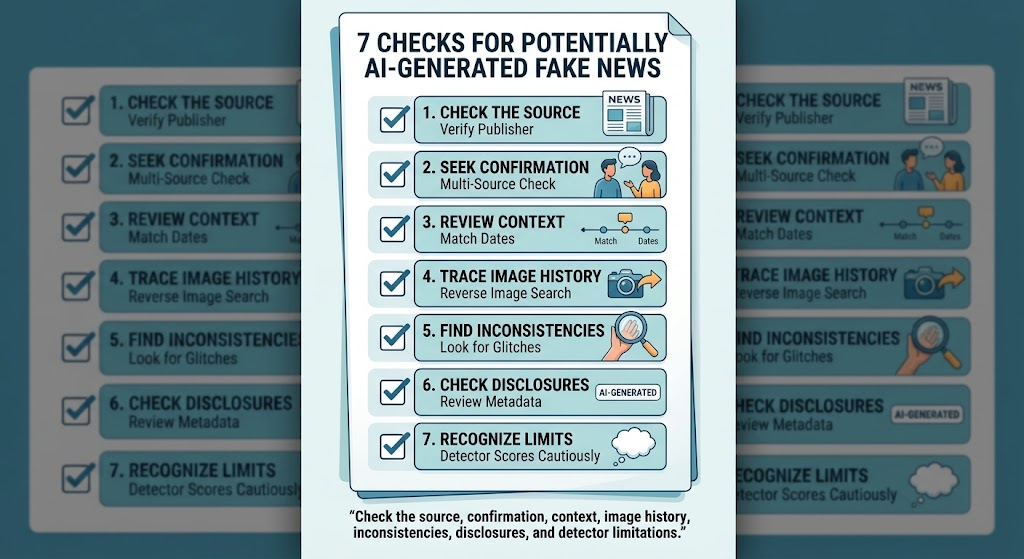
These seven checks will help you decide what deserves your trust—and what needs more investigation.
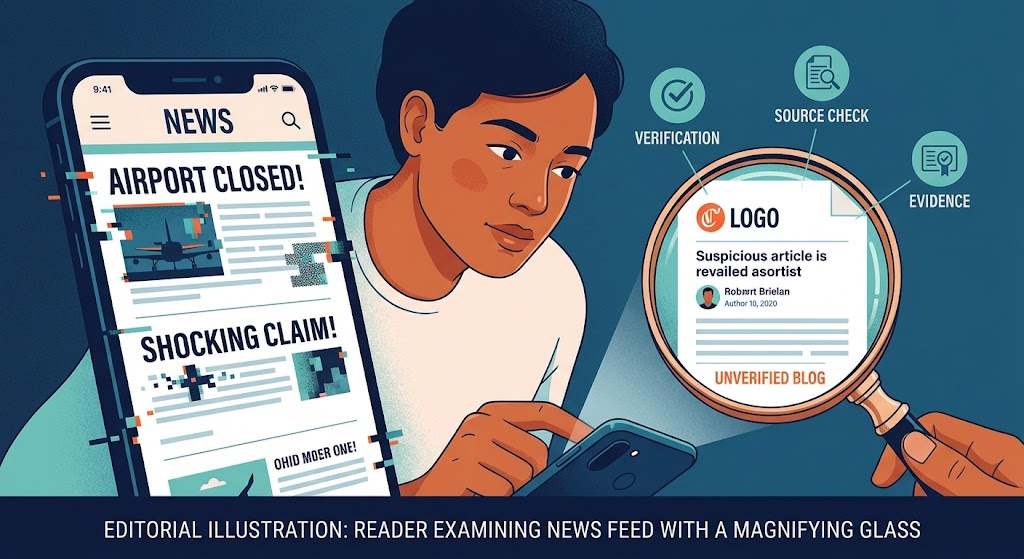
1. Check Who Published the Story
Look beyond the logo
Before reading further, check the website address or social media handle. An impersonator can copy a familiar publisher’s name and appearance while using a different address.
Open the website’s About page. Look for an identifiable publisher, contact information, and an explanation of its editorial work. Full Fact recommends checking unfamiliar sources and watching for websites designed to resemble legitimate outlets.
Trace screenshots back to a live source
If someone shares a screenshot of an alleged news article, search for its headline on the publisher’s actual website. A screenshot alone gives you no way to inspect its links, publication history, or corrections.
Ask yourself: Can I find this story where it supposedly originated?
2. Look for Independent Confirmation
Search for the specific claim
Search using the names, location, and event described in the story. Compare coverage from established news organizations and relevant primary sources.
For example, if a post claims that an airport has closed, check the airport’s own announcements alongside local reporting.
The Associated Press includes checking for similar reports from trusted media in its guidance for verifying potentially AI-generated material.
Check whether the reports share one source
Several websites repeating the same anonymous post do not provide several independent confirmations. Follow their links to see whether each outlet has gathered evidence or simply copied the original claim.
Ask yourself: Are there separate sources supporting this, or is everyone repeating one account?
During breaking news, a lack of confirmation should leave a claim unverified. It does not, by itself, prove the story is false.
3. Verify the Dates, Quotes, and Evidence
Separate the publication date from the event date
A recent post can contain old footage. Check when the article was published, when the event supposedly happened, and whether the image or video matches that timeline.
Full Fact warns that genuine images can mislead when paired with a false date or caption.
Follow the links behind important claims
If an article cites a study, report, or public statement, open the original. Check whether it supports the headline.
For quotes, look for a full interview, transcript, recording, or official statement. Read the surrounding passage: a sentence may change meaning when removed from its context.
Ask yourself: Does the evidence support the exact claim being made?
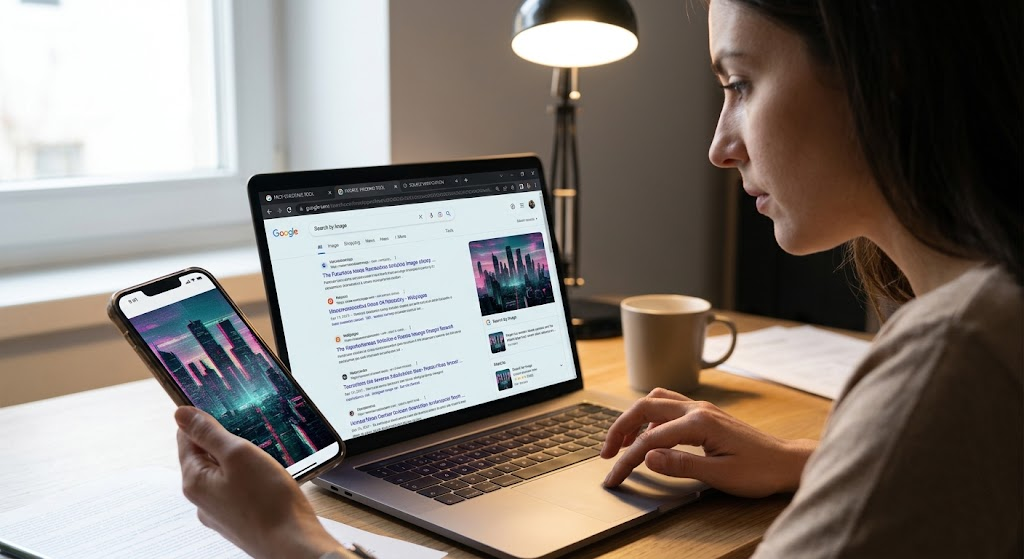
4. Run a Reverse Image Search
Find where the picture has appeared before
A reverse image search lets you search using a picture instead of keywords. Google Lens can return similar images and websites containing the image or something visually similar.
A useful approach is to:
- Save the image or take a clear screenshot.
- Upload it to an image-search tool.
- Open relevant matches.
- Compare dates, captions, locations, and sources.
For a video, try searching a screenshot from a distinctive moment.
Interpret the results carefully
An older version may reveal that a supposed current event actually happened elsewhere or years earlier. A creator’s original post may identify the picture as an AI illustration.
No matches leave the origin unresolved. Keep checking rather than treating an empty search as proof of authenticity.
5. Examine Images, Video, and Audio for Inconsistencies
Inspect details, not just the overall impression
Look closely for distorted objects, unreadable signs, or body parts that merge unnaturally. Full Fact’s investigations have identified these kinds of inconsistencies in suspected AI-generated images.
For video, pause at several moments. Watch for facial glitches or mouth movements that do not match the speech. In audio, listen for unusual pronunciation, abrupt changes, or inconsistent background noise.
Treat odd details as clues
Compression, motion blur, dubbing, and ordinary editing can also produce strange results. Conversely, a convincing fake may contain no obvious mistakes.
Ask yourself: Does this detail warrant further investigation?
Visual or audio inspection should support your source checks, rather than replace them.
6. Look for AI Disclosures and Content Credentials
Read labels and captions
Check whether the publisher identifies the content as an illustration, reconstruction, satire, or AI-generated media. Also look at the creator’s original post: the disclosure may disappear when someone reposts the material.
Examine the recorded creation history
Where available, Content Credentials can provide information about how a file was created and modified, including the tools or processes used. They can help you investigate its origin.
Keep two limits in mind:
- A file’s creation history does not independently establish whether every accompanying claim is accurate.
- Missing credentials do not settle the file’s origin; C2PA explains that this metadata can be removed.
Ask yourself: What does the available history actually establish?
7. Use AI Detectors Cautiously—and Pause Before Sharing
A detector score is not a verdict
An automated tool may classify material as AI-generated, but that result should not decide whether a story is true. Full Fact reports that it has not found AI detection tools sufficiently reliable for routine use in its investigations of suspected synthetic content.
Likewise, asking a chatbot whether a story is genuine does not replace checking the sources it provides.
Notice your reaction
If a post makes you immediately angry, frightened, or excited, pause. Full Fact notes that misleading content can exploit those feelings to encourage clicks and sharing.
Before forwarding it, ask:
- Have I identified the original source?
- Have I checked the supporting evidence?
- Can I describe the claim as confirmed, false, or still unverified?
When the evidence remains unclear, hold off sharing it as fac
What to Do When You Still Cannot Verify a Story
You do not need to determine exactly how a suspicious post was created before deciding it lacks adequate evidence.
Keep the original link, look for further reporting, or submit the claim to a fact-checking organization. If you already shared something that turns out to be false, correct it clearly and include the supporting evidence.
The most useful habit is to make verification part of reading the news: identify the source, examine the evidence, and share only what you can responsibly support.










One Comment
Здесь портале можно обнаружить нужную информацию.
https://relax-spb.ru/read-info/1055-dve-nedeli-ogranicheniya-dvizheniya-na-klyuchevom-perekryostke-ulyanovska.html