
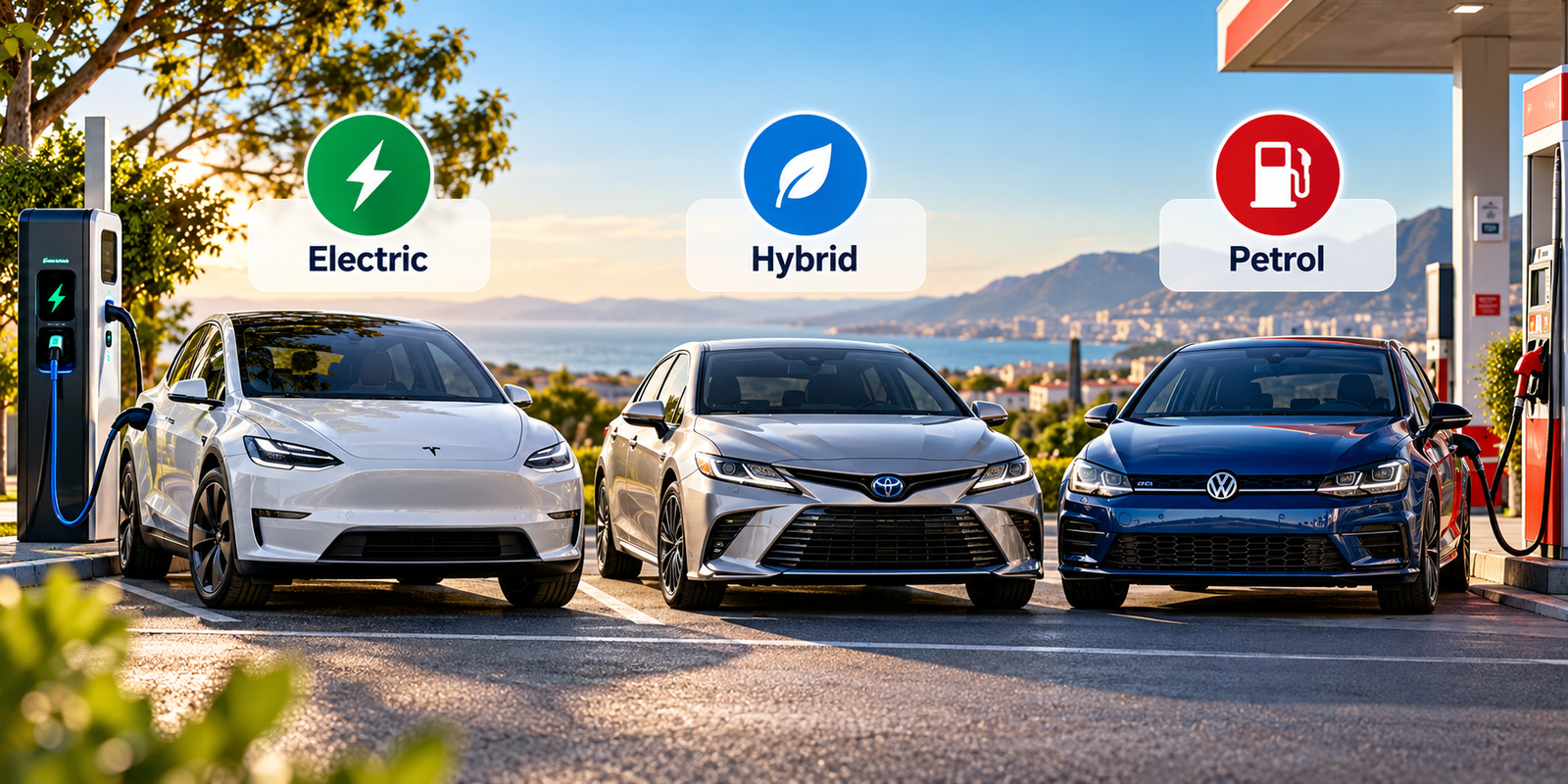
Electric vs hybrid vs petrol cars: which costs less to own? The answer depends on purchase price, depreciation, annual mileage, energy prices, maintenance, insurance, and charging access.
An electric car can offer inexpensive home charging. A full hybrid can reduce fuel consumption without needing a plug. A petrol car might have a lower purchase price.
This guide compares the main ownership costs and includes a clearly labeled, fictional five-year example to help you understand the calculation.
Understanding Electric, Hybrid, and Petrol Cars
Electric cars
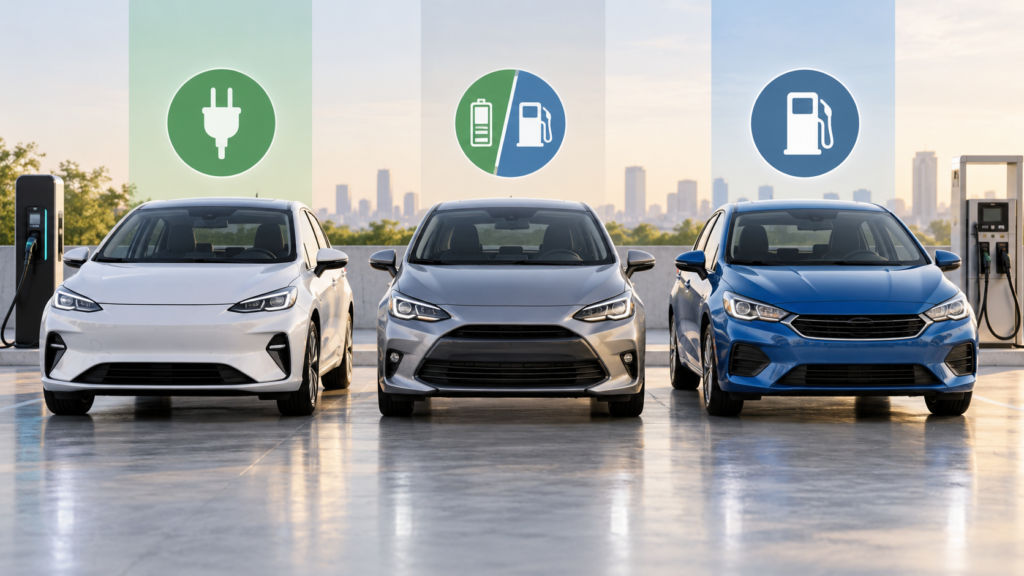
A battery electric vehicle, or BEV, uses an electric motor powered by a rechargeable battery. It does not have a petrol engine and needs access to charging.
Your energy bill therefore depends on electricity consumption and the price you pay to charge.
Full hybrid cars
A conventional full hybrid combines a petrol engine with an electric motor and battery. It charges its battery through regenerative braking and the engine, rather than through an external charging point.
It still uses petrol, but the electrical system helps reduce fuel consumption.
Petrol cars
A conventional petrol car relies on an internal combustion engine. Its fuel bill depends on the amount of petrol consumed and the price per litre.
Compare vehicles of similar size, equipment, and performance. A small petrol hatchback and a large electric SUV are unlikely to provide a useful ownership-cost comparison.
Where do plug-in hybrids fit?
A plug-in hybrid, or PHEV, has both an engine and a battery that can be charged externally. It can cover some journeys using electricity before relying more heavily on its engine.
Its costs require a separate calculation using both electricity and petrol consumption. The hybrid in the worked example below is a full hybrid, not a plug-in hybrid.
What Is Total Cost of Ownership?
To compare electric vs hybrid vs petrol cars fairly, calculate ownership costs over the same number of years and kilometres. Include depreciation, fuel or electricity, maintenance, insurance, taxes, financing, and any charging installation costs.
Total cost of ownership measures what you spend over the period you keep a vehicle, accounting for its value when you sell it.
A practical calculation is:
Ownership cost = purchase price − resale value + energy + maintenance and repairs + insurance + taxes and fees + financing costs + charging installation − applicable incentives.
Subtract an incentive only if it has not already been included in the purchase price.
The International Energy Agency uses ownership-cost comparisons to show how changing assumptions can change the relative cost of conventional and electrified vehicles.
Why depreciation matters
Depreciation is the difference between what you pay for a car and what you recover when selling it.
A vehicle that saves money on energy can still cost more overall if it loses substantially more value. Treat future resale prices as estimates and test more than one scenario.
Electric vs Hybrid vs Petrol Running Costs
An illustrative annual energy comparison
The following example uses fictional euro-denominated inputs, not current prices or estimates for specific models. Replace them with prices and consumption figures relevant to your location.
Assume:
- Annual driving: 15,000 km.
- Petrol consumption: 6.5 litres per 100 km.
- Full hybrid consumption: 4.5 litres per 100 km.
- EV electricity consumption: 18 kWh per 100 km, measured as electricity purchased, including charging losses.
- Petrol price: €1.60 per litre.
- Home electricity price: €0.25 per kWh.
- Public charging price: €0.65 per kWh.
| Vehicle and charging scenario | Energy cost per 100 km | Annual energy cost |
|---|---|---|
| Petrol car | €10.40 | €1,560 |
| Full hybrid | €7.20 | €1,080 |
| Electric car charged entirely at home | €4.50 | €675 |
| Electric car charged entirely in public | €11.70 | €1,755 |
Under these assumptions, home charging gives the EV the lowest energy cost. However, the public-charging scenario costs more than either petrol option.
These are the results of this example, not a universal ranking.
Calculate your own energy bill
For petrol and full hybrid vehicles:
Annual fuel cost = annual kilometres ÷ 100 × litres per 100 km × price per litre.
For an electric vehicle:
Annual charging cost = annual kilometres ÷ 100 × purchased kWh per 100 km × electricity price per kWh.
If you use several charging locations, calculate the cost of electricity purchased at each. Add any session, parking, subscription, or idle fees separately.
Home Charging vs Public Charging
Check the tariff you will actually use
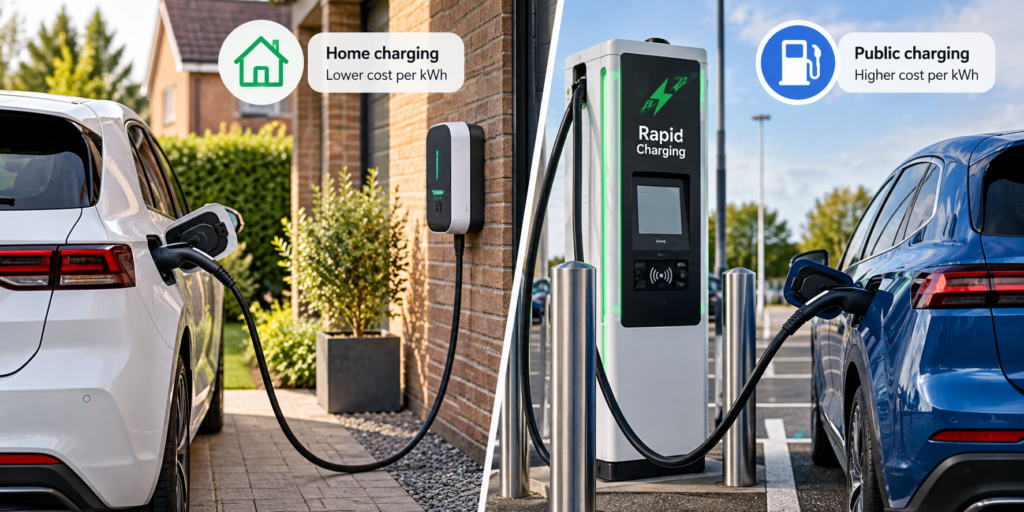
Home charging typically costs less than public charging, according to the U.S. Department of Energy’s Alternative Fuels Data Center. Your own tariffs determine the actual difference.
Before buying an EV, check:
- Whether you have reliable charging access.
- Your electricity tariff and any relevant time-based rates.
- Charger installation costs.
- Prices at the public stations you expect to use.
Account for your real journeys
A driver who charges at home most nights has a different cost profile from someone who depends on public chargers.
Long journeys can also change the mix. Check compatible chargers along your usual routes and allow for the effects of terrain, loads, heating, and air conditioning on range.
Maintenance Costs Across the Three Options
Electric cars generally need less routine maintenance
Battery electric vehicles have fewer moving parts and do not need engine oil changes. Regenerative braking can also reduce brake wear.
They still need tyres, inspections, and other maintenance specified by the manufacturer. Lower servicing requirements do not eliminate the possibility of repairs.
Hybrids still have an engine to maintain
Full hybrids and plug-in hybrids retain an internal combustion engine, so their general maintenance requirements resemble those of conventional cars. Their regenerative braking systems can reduce brake wear.
Compare service schedules and local repair quotes for the models you are considering.
Check battery condition and warranty coverage
For a used electric or hybrid car, ask about battery condition, warranty terms, and available diagnostic reports.
Battery replacement outside warranty can be a significant expense. However, it should not automatically be treated as a routine cost that every owner will face.
A Five-Year Ownership Cost Comparison
Add purchase price, resale value, and other expenses
Now extend the energy example to five years and 75,000 km.
Every input below is a fictional assumption chosen to demonstrate the method. Maintenance and repairs include a tyre allowance. Insurance and taxes are held equal to isolate other differences.
The example assumes cash purchases, no financing costs, no incentives, and unchanged energy prices. It does not account for investment returns or the time value of money.
| Cost over five years | Petrol | Full hybrid | EV: home charging | EV: public charging |
|---|---|---|---|---|
| Purchase price | €24,000 | €26,500 | €30,000 | €30,000 |
| Assumed resale value, subtracted | €12,000 | €14,000 | €15,000 | €15,000 |
| Energy | €7,800 | €5,400 | €3,375 | €8,775 |
| Maintenance, repairs, and tyres | €3,000 | €2,500 | €2,000 | €2,000 |
| Insurance | €5,000 | €5,000 | €5,000 | €5,000 |
| Taxes and registration fees | €1,000 | €1,000 | €1,000 | €1,000 |
| Home charger installation | €0 | €0 | €1,000 | €0 |
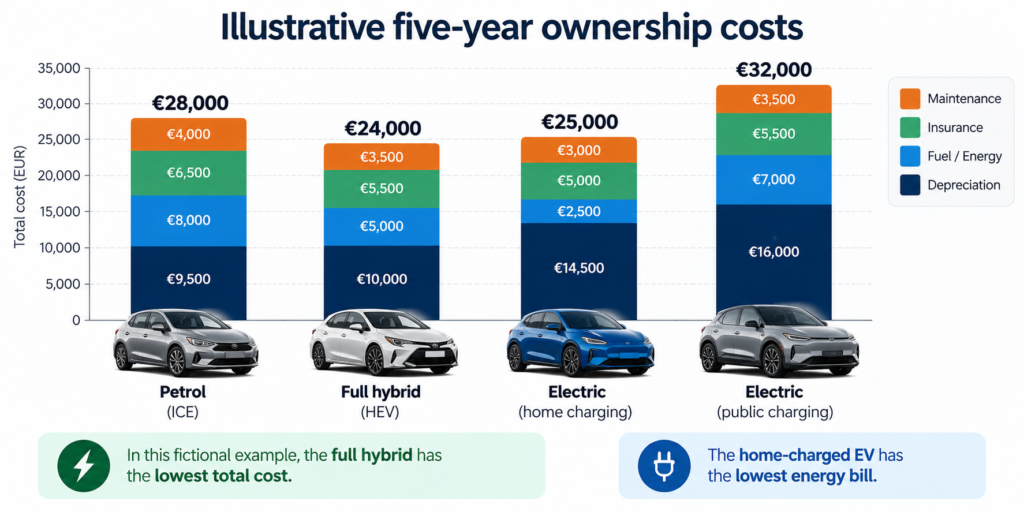
| Total ownership cost | €28,800 | €26,400 | €27,375 | €31,775 |
What does the example show?
The full hybrid has the lowest five-year ownership cost in this scenario.
The home-charged EV spends the least on energy, but its assumed depreciation and charger installation leave its total €975 above the hybrid.
A change in purchase price, resale value, mileage, or charging tariff could reverse that result. That is why comparing actual models matters more than choosing a powertrain label.
Which Car Could Cost Less for Your Driving?
An electric car: test the case for affordable charging
An EV deserves consideration when you have dependable, reasonably priced charging and drive enough for energy savings to matter.
Check the purchase-price difference, installation cost, insurance quote, and expected resale value before concluding that it will save money.
A full hybrid: compare fuel savings with the price premium
A full hybrid offers a way to reduce petrol consumption without arranging plug-in charging.
Its value depends on the specific vehicle and your driving pattern. FuelEconomy.gov’s hybrid comparison tool lets users adjust annual mileage, city driving, and fuel prices to examine savings and payback periods.
A petrol car: examine lower purchase costs and low mileage
A substantially cheaper petrol car can remain competitive when you drive relatively little. In that situation, annual energy savings may take longer to offset a higher purchase price.
Include the option of keeping your existing car in the comparison. Buying a more efficient replacement introduces purchase and depreciation costs that fuel savings alone may not recover.
How to Compare Cars Before Buying
Use the same ownership period
Compare every option over the same number of years and kilometres.
Get model-specific quotes
Collect purchase prices, insurance quotes, maintenance estimates, and charging installation costs where relevant.
Test uncertain assumptions
Recalculate using different resale values and energy prices. Check whether the result changes if you drive fewer kilometres or use more public charging.
Check local taxes and incentives
Include only rules and benefits that apply to your location and purchase. Verify current eligibility before adding an incentive to your budget.
Frequently Asked Questions
Are electric cars always cheaper than petrol cars?
No. An EV can have lower energy and servicing costs without having the lowest total ownership cost. Purchase price, depreciation, insurance, and charging costs can change the result.
Is a hybrid cheaper if I cannot charge at home?
A conventional full hybrid does not need external charging. Whether it costs less than an EV depends on the vehicles and the public or workplace charging prices available to you.
Should I compare advertised monthly payments?
Monthly payments help assess affordability, but they do not reveal total cost. Compare deposits, interest, fees, final payments, and the vehicle’s value at the end of the agreement.
Choose Using Your Own Numbers
Start with three comparable vehicles and calculate the cost of keeping each for your intended ownership period.
Use realistic charging access, annual mileage, and model-specific quotes. Then test uncertain resale values and energy prices.
The most economical choice is the vehicle with the lowest credible total cost that also meets your driving needs.